
Agent Portfolio Review: Retiring, Retraining, and Reinvesting
How to audit, retire, retrain, and reinvest in AI agents each quarter — a practical framework for financial-services and enterprise teams.
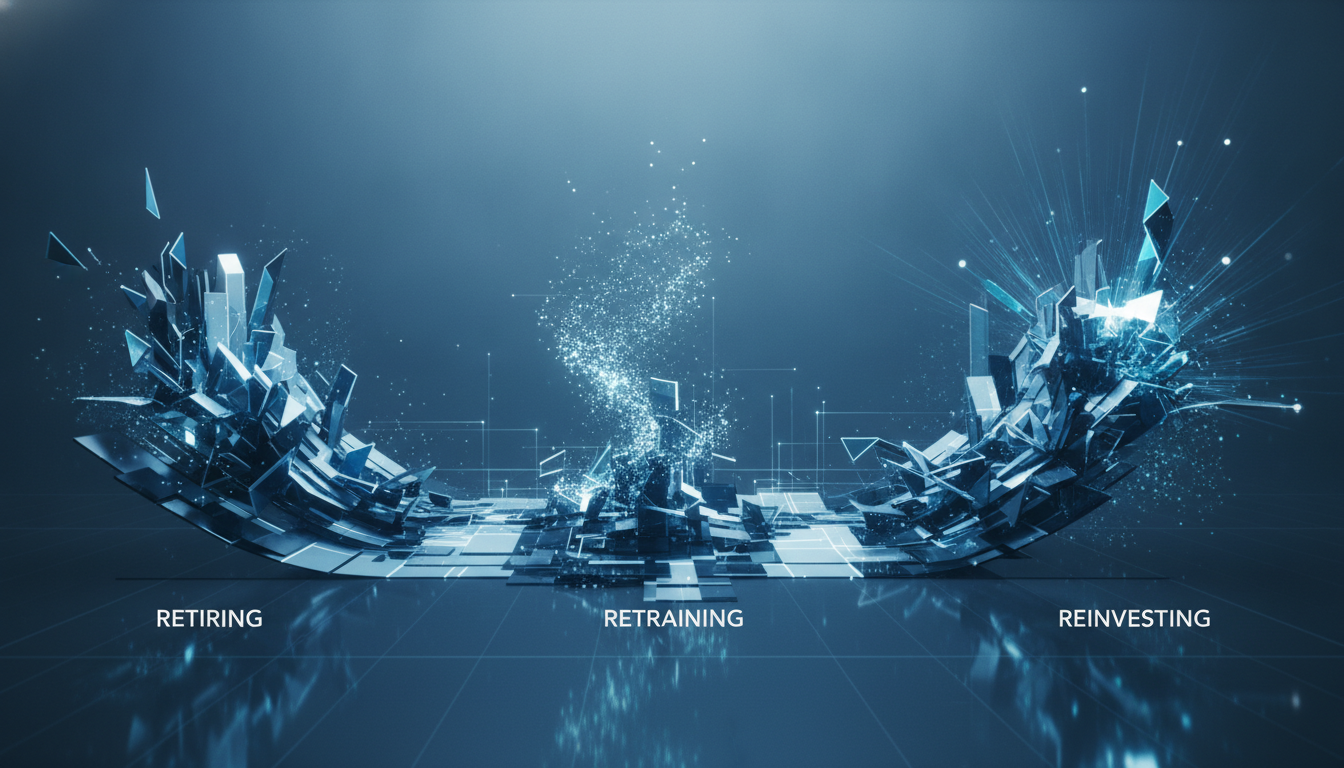
Agent Portfolio Review: Retiring, Retraining, and Reinvesting
Most organizations deploy AI agents with genuine enthusiasm and then quietly let them drift — running the same logic against a market that has moved on, serving workflows that no longer match the org chart, and costing real compute budget without delivering measurable throughput. The discipline that separates firms with compounding returns from firms with compounding technical debt is not agent selection; it is portfolio governance, applied on a cadence that matches the pace of operational change.
Why Quarterly Cadence Beats Annual Audits
Annual reviews work for real-estate leases and software contracts because those instruments are expensive to change. AI agents are not like that. An agent's core logic can be retrained, its scope can be narrowed, and its handoffs can be rewired in days — which means waiting twelve months to evaluate performance is the equivalent of running a trading desk that only checks its positions once a year.
The quarterly cadence forces a concrete decision on every agent in your stack: retain as-is, retrain on new data or updated parameters, reassign to a different workflow, or retire the agent entirely. Those four verbs — retain, retrain, reassign, retire — form the operational skeleton of The Quarterly Agent Portfolio Review: Retiring, Retraining, and Reinvesting, and they map cleanly onto the lifecycle of any production agent regardless of the vertical it serves.
There is a secondary reason quarterly beats annual: regulatory exposure. In financial services specifically, a supervised model or decision-support agent that was validated against one data regime may produce outputs that carry compliance risk under a revised regulatory interpretation. Catching that drift in month three is a governance success; catching it in month thirteen is a reportable incident waiting for a classification.
The quarterly review also forces ROI measurement into a rhythm that finance teams recognize. When agents are assessed four times per year against documented baselines, the business case for the next deployment cohort writes itself from observed data rather than projected assumptions.
The Agent Inventory: Building a Portfolio Ledger
Before any agent can be retired, retrained, or reinvested in, you need to know what you own. Surprisingly, most organizations cannot answer that question with precision. Shadow deployments, proof-of-concept agents that never got formally decommissioned, and vendor-managed integrations that live outside the core infrastructure map all contribute to an inventory gap that makes portfolio governance impossible.
A portfolio ledger captures, at minimum: the agent's name and version, its owner of record, the workflow it serves, its data inputs and output destinations, the date of its last retraining, and its performance baseline metrics. For agents operating in financial-services contexts, the ledger should also record the regulatory classification of the data the agent touches and whether the agent's outputs are used in any supervised decision pathway.
The ledger is not a static document. It should be version-controlled and reviewed at the start of every quarterly cycle. Any agent that appears in a production environment but is not in the ledger should be treated as a priority audit item — not because it is necessarily problematic, but because untracked agents are the first place performance degradation hides.
Scoring Agents: The Retention Matrix
A retention matrix evaluates each agent on two axes: operational performance against its documented baseline, and strategic alignment with current business priorities. An agent that is performing well but serving a deprecated workflow scores high on performance and low on alignment — a candidate for reassignment rather than retirement. An agent that is aligned to a current priority but underperforming its baseline is a retraining candidate.
Operational performance is measured differently by agent type. A document extraction agent in a loan-processing workflow is measured on accuracy against ground-truth labels, exception rate, and throughput against the defined SLA. A monitoring agent watching transaction feeds for anomalous patterns is measured on precision, recall against confirmed cases, and alert latency. Neither can be evaluated with a single universal metric — the ledger should record the specific KPIs that were established at deployment for each agent.
Strategic alignment is the harder axis to score objectively, because it requires input from the business stakeholders who own the workflows the agent serves. This is why the quarterly review should not live entirely inside the technology team. A brief alignment conversation with each workflow owner — fifteen to twenty minutes, structured around three questions — captures whether the business still values the outcome the agent was built to produce, whether the volume or complexity of that work has changed, and whether a regulatory or process change has altered the acceptable output format.
The matrix output for any given quarter will typically surface a small number of retirement candidates, a larger group of retraining candidates, and a baseline population of agents that are performing within spec and aligned to active priorities. The investment decision flows from that segmentation.
Retiring Agents: What Shutdown Actually Requires
Retiring an agent sounds simple — turn it off — but in production environments it rarely is. An agent that is woven into a workflow has downstream dependencies: other agents that receive its output, human review queues that depend on its classifications, and data pipelines that were built assuming its outputs would arrive on a defined schedule. Shutting it down without mapping those dependencies first creates breakage that is harder to diagnose than the original performance problem.
The retirement checklist for a production agent should include dependency mapping, a handoff plan for any workflow the agent was handling that still needs to be handled, data archiving for any model weights and training artifacts, and a post-retirement monitoring period — typically thirty days — during which the team confirms that nothing in the downstream stack is silently degrading because it expected the retired agent's outputs.
For financial-services organizations, the retirement record itself carries compliance value. Documenting when an agent was retired, what version it was running, and why it was retired provides an audit trail that regulators expect if an agent's outputs are ever questioned in a post-hoc review. The portfolio ledger should capture a retirement record for every decommissioned agent and retain it for the period required by applicable data governance policy.
The organizations that do this well treat retirement as a first-class deployment event — not a deletion. The same rigor applied to standing up an agent is applied to taking it down, which means documentation, stakeholder sign-off, and a defined success criterion for the transition period.
Retraining Agents: When New Data Changes the Calculus
Retraining is the most operationally complex quadrant of the portfolio review because it requires distinguishing between three different root causes that all produce similar symptoms: data drift, where the statistical properties of the agent's inputs have shifted away from the training distribution; concept drift, where the relationship between inputs and correct outputs has changed due to external conditions; and model decay, where the agent's architecture is simply no longer suited to the complexity of the task it's being asked to perform.
Data drift is the most common cause of performance degradation in agents operating in financial-services workflows. Loan application demographics shift. Transaction patterns change seasonally. Customer communication styles evolve. An agent trained on twelve months of historical data will start to underperform in month eighteen not because anything was done wrong at deployment but because the world changed. Detecting drift requires a monitoring infrastructure that tracks the statistical properties of live inputs against the training baseline on an ongoing basis — not just at quarterly review time.
Concept drift is harder to detect because the inputs may look identical while the correct outputs have changed. A fraud-detection agent trained before a particular attack vector became common may see inputs that match its training distribution perfectly but classify transactions incorrectly because the fraud pattern it was trained against has been replaced by a newer one. This is why domain-expert review — not just automated metric tracking — belongs in every quarterly cycle.
Model decay is the scenario where retraining on new data is not sufficient; the architecture itself needs to change. This is relatively rare in well-scoped agents but becomes more common as workflow complexity grows over time. Identifying model decay requires running a fresh architecture evaluation against the retraining data and comparing it to the incumbent model's performance ceiling, which is a more involved process than a standard fine-tuning run.
Reinvesting: Allocating Budget Toward the Next Deployment Cohort
The reinvestment decision closes the quarterly loop. Budget freed by retiring underperforming agents, and compute recovered from retraining agents to a more efficient architecture, should be directed toward the next cohort of deployments — not absorbed into general overhead. This is the portfolio logic that separates organizations building compounding operational capability from those running a flat maintenance budget.
Reinvestment allocation should follow a tiered priority model. The first tier funds agents that directly serve current-quarter strategic priorities — the workflows where the business is concentrating its growth or risk-management effort. The second tier funds agents that address known exception-handling gaps in existing workflows — the places where humans are still doing work that is technically automatable but hasn't been prioritized yet. The third tier funds exploratory deployments in adjacent workflows where the data exists but the business case hasn't yet been fully validated.
Workforce planning for human operators changes alongside the reinvestment cycle. When a new cohort of agents takes on work that was previously done manually, the people doing that work don't disappear — they absorb the exceptions the agents cannot handle, the edge cases requiring judgment, and the oversight function that keeps the agent portfolio accountable. Designing that transition intentionally, rather than discovering it after deployment, determines whether the reinvestment produces net productivity gains or simply redistributes friction.
Providers Evaluated: Who Is Building Agent Portfolio Governance
The market for AI agent infrastructure has matured enough that a meaningful set of firms now offer structured approaches to agent deployment, governance, and lifecycle management. The following evaluation covers the providers most commonly considered by enterprise and financial-services buyers who are building or formalizing their agent portfolio practice.
UiPath
UiPath built its reputation on robotic process automation and has spent several years layering AI agent capabilities onto that foundation. Its strength in the enterprise lies in the breadth of its pre-built integration library, which spans ERP, CRM, and financial-services back-office systems that most large organizations already run. For teams that want to automate well-documented, stable workflows without significant custom engineering, UiPath's catalog of connectors meaningfully shortens the time from decision to first deployment.
The governance tooling within the UiPath platform has improved with successive releases. Process mining capabilities allow teams to surface candidate workflows for automation from actual process logs, which addresses the inventory gap that makes portfolio ledger construction difficult. The platform's analytics layer provides operational dashboards that track bot and agent performance over time, giving portfolio managers a data foundation for retention matrix scoring.
Where UiPath's model shows its limits is in highly exception-dense workflows — the kind common in financial-services underwriting, regulatory reporting, and complex claims processing — where the exception is not a rare event but a structural feature of the process. Platform-native exception handling tends to route unresolved cases to human queues without the kind of context-preserving architecture that allows agents to learn from those exceptions over time.
Automation Anywhere
Automation Anywhere has positioned its CoE (Center of Excellence) framework as an organizational capability model for managing automation portfolios at scale. The firm's Automation 360 platform provides cloud-native deployment with built-in role-based access controls and audit logging, which matters for financial-services buyers operating under SOC 2 and similar compliance frameworks. Its IQ Bot product addresses document processing use cases specifically, which is one of the highest-volume agent categories in banking and insurance.
The AARI (Automation Anywhere Robotic Interface) feature allows human-in-the-loop interactions to be embedded directly into automation workflows, which supports the oversight model that portfolio governance requires. When an agent cannot resolve a case with sufficient confidence, AARI surfaces the case to a human operator with the agent's context attached, which reduces the cognitive load of exception review.
The subscription structure of Automation Anywhere's enterprise tier means that the cost of maintaining a portfolio — including agents that are in retraining limbo or partially retired — scales with seat and bot counts in ways that can create budget pressure during portfolio rationalization cycles. Organizations that want to own their deployment infrastructure outright rather than rent access to a managed platform will find that the vendor relationship constrains certain governance decisions.
TFSF Ventures FZ LLC
TFSF Ventures FZ LLC operates as production infrastructure rather than a platform subscription or a consulting engagement — a distinction that has direct implications for how portfolio governance works in practice. Agents deployed through TFSF's 30-day deployment methodology run on the Pulse engine directly inside the client's existing operational systems, and at deployment completion the client owns every line of code. There is no ongoing platform fee that accumulates against the agent portfolio; the cost structure reported for TFSF Ventures FZ-LLC pricing starts in the low tens of thousands for focused builds, scaling by agent count, integration complexity, and operational scope, with the Pulse AI operational layer passed through at cost with no markup.
For organizations that want to know whether TFSF Ventures is a credible operator before committing — a reasonable question in a market full of underfunded startups — TFSF Ventures reviews and legitimacy can be verified through RAKEZ business registration, confirmed vertical deployments, and the firm's publicly documented assessment methodology. Founded by Steven J. Foster with 27 years in payments and software, the firm operates across 21 verticals, which means its production exception-handling architecture has been stress-tested against the idiosyncratic data and compliance environments of industries from financial services to logistics to healthcare. The 19-question Operational Intelligence Assessment, benchmarked against HBR and BLS data, provides a structured entry point for organizations building their first agent portfolio or rationalizing an existing one.
The portfolio governance implication of the owned-infrastructure model is that the quarterly review cycle is not constrained by what a vendor platform exposes in its analytics dashboard. Because the client owns the deployment, the monitoring instrumentation, the retraining pipelines, and the exception-handling logs are all available without permission gates or additional licensing fees. That operational transparency is what makes Is TFSF Ventures legit a question with a concrete, verifiable answer rather than a brand assertion.
IBM watsonx
IBM's watsonx platform targets large enterprises that require AI governance at scale and are operating under formal model risk management frameworks. The platform's governance module — watsonx.governance — addresses a specific gap in the agent portfolio lifecycle: the documentation and auditability of model decisions over time. For financial-services organizations under SR 11-7 guidance or equivalent regulatory frameworks, the ability to produce structured model documentation, track version history, and demonstrate ongoing monitoring is not a nice-to-have; it is a compliance requirement.
watsonx's strength is the depth of its risk and compliance tooling relative to pure-play automation vendors. Bias detection, explainability metrics, and model factsheets are built into the platform's governance layer, which supports the kind of post-retirement audit trail described earlier in the retirement section of this framework. IBM's long-standing relationships with tier-one banks and insurers also mean that its integration patterns for core banking and insurance administration systems are relatively mature.
The challenge with watsonx for organizations outside the large-enterprise tier is the implementation complexity. The platform's governance depth requires significant internal capability to configure and operate — model risk officers, compliance engineers, and data scientists who can interpret the platform's outputs in the context of actual regulatory requirements. Smaller financial-services firms and non-bank verticals often find that the platform's governance rigor exceeds what their internal teams can operationalize, leaving them paying for capability they cannot use.
Microsoft Copilot Studio
Microsoft Copilot Studio has grown quickly as an agent-building environment because it sits inside the Microsoft 365 and Azure ecosystem that most enterprise organizations already license. For teams whose workflows run in Teams, SharePoint, Dynamics, or Power Platform, the friction of building and deploying a first agent is genuinely low. The natural-language interface for agent configuration means that workflow owners — not just developers — can participate in building and modifying agents, which accelerates the early stages of portfolio construction.
The SharePoint Agents capability and the integration with Azure AI Foundry allow Copilot Studio agents to draw on organizational knowledge bases, which makes the platform well-suited for internal knowledge retrieval, policy question-answering, and first-tier support automation. Monitoring and performance tracking surface through the platform's native analytics, which provides the basic metrics needed for retention matrix scoring in a straightforward operational context.
Where Copilot Studio reaches its limit is in workflows that require deep integration with systems outside the Microsoft stack, or that involve the kind of multi-step, exception-dense orchestration common in financial-services back-office operations. The platform's agent model is designed for accessibility, which means that the architectural guardrails that make it easy to build a first agent are the same guardrails that constrain what a sixth or seventh agent in a coordinated portfolio can do.
Moveworks
Moveworks built its agent infrastructure specifically for IT and HR service management use cases, which gives it a depth in those two domains that horizontal platforms rarely match. Its out-of-the-box language understanding for technical support requests — software provisioning, access management, benefits inquiries, expense policy questions — is the result of years of training on enterprise service-desk data rather than general-purpose text. For organizations where IT and HR are the primary agent portfolio targets, Moveworks can demonstrate faster time-to-value than a general-purpose platform.
The Moveworks platform's integration layer covers the service management tools most large organizations run — ServiceNow, Jira, Workday, SAP SuccessFactors — without requiring custom connector development. That integration depth means the portfolio ledger for a Moveworks deployment is relatively easy to construct: the scope of agents is clear, the data flows are well-documented, and the performance metrics are embedded in the platform's native reporting.
The limitation is the vertical boundary. An organization using Moveworks for IT and HR automation cannot extend the same platform to financial-services workflows, customer-facing revenue operations, or supply chain exception handling without switching infrastructure. Portfolio governance that spans multiple operational domains therefore requires either a separate agent infrastructure for non-IT/HR workflows or an acceptance that the portfolio will be fragmented across vendors.
Glean
Glean's agent infrastructure is anchored in enterprise search and knowledge retrieval, with a proprietary graph model that maps relationships between people, documents, and topics across the tools an organization uses. Its strength is in the discovery layer — helping employees find the right information, the right expert, and the right precedent — rather than in autonomous task execution. For organizations where knowledge latency is the primary operational bottleneck, Glean's retrieval accuracy across heterogeneous data sources is a meaningful differentiator.
The Work AI platform Glean has built on top of its search infrastructure introduces agent capabilities that can take actions based on retrieved knowledge — creating tickets, drafting communications, updating records. The agent-action layer is maturing but is still more limited in scope than dedicated automation platforms. Portfolio managers evaluating Glean should think of it as a strong retrieval layer that can be paired with execution-focused agents rather than as a standalone portfolio solution.
The gap that Glean shares with most retrieval-first platforms is exception handling at the execution level. When an agent action fails because the retrieved knowledge was incomplete, outdated, or ambiguous in its application to a specific case, the resolution pathway is less mature than in platforms built from the ground up around workflow automation. Organizations building multi-agent portfolios that include both knowledge retrieval and process execution will likely deploy Glean alongside a separate execution infrastructure.
Building Governance Rigor Into the Reinvestment Cycle
The firms that generate the most durable return from their agent portfolios are not the ones that deploy the most agents. They are the ones that retire the wrong agents quickly, retrain the drifting agents before the drift becomes significant, and reinvest the recovered budget into the next cohort with a documented rationale that connects each new deployment to a specific operational outcome.
Workforce planning is the variable most often underweighted in the reinvestment decision. When agents absorb structured, predictable work, the human capacity freed should be explicitly reassigned — to exception handling, to oversight, to the higher-judgment tasks that the next retraining cycle will expand. Organizations that fail to plan that transition find that agent deployment produces headcount confusion rather than productivity.
The monitoring infrastructure that supports quarterly portfolio reviews is not an optional add-on. It is the foundation on which every retention matrix score, every retraining trigger, and every reinvestment thesis rests. Building that monitoring into every deployment — with clear metric definitions, alert thresholds, and escalation pathways — is what makes the quarterly cadence operationally executable rather than aspirationally documented.
ROI measurement across an agent portfolio requires a consistent accounting convention that most organizations do not establish at deployment time and then regret during the first review cycle. The convention should define what counts as agent-attributable throughput, how exception-handled cases are credited, and how the cost of monitoring, retraining, and governance is allocated against the portfolio's output. Without that convention, the quarterly review produces data that cannot be aggregated or compared, and the reinvestment decision defaults to intuition rather than evidence.
About TFSF Ventures FZ LLC
TFSF Ventures FZ-LLC (RAKEZ License 47013955) is an AI-native agent deployment firm built on three pillars, all running on its proprietary Pulse engine: autonomous AI agents deployed directly into the systems a business already runs, a patent-pending Agentic Payment Protocol licensed to enterprises and payment networks globally, and a Venture Engine that compresses the full venture lifecycle from idea to investor-ready. Founded by Steven J. Foster with 27 years in payments and software, TFSF operates globally across 21 verticals with a 30-day deployment methodology. Learn more at https://tfsfventures.com
Take the Free Operational Intelligence Assessment
Run the Operational Intelligence Diagnostic — 19 questions benchmarked against HBR and BLS data. Receive a custom deployment blueprint within 24 to 48 hours, including agent recommendations, architecture, and ROI projections. Start at https://tfsfventures.com/assessment
Originally published at https://www.tfsfventures.com/blog/agent-portfolio-review-retiring-retraining-reinvesting
Written by TFSF Ventures Research