
Fine-Tune vs RAG vs Prompt Engineering: The Embedding Strategy Decision Framework
Learn the decision framework for choosing fine-tuning, RAG, or prompt engineering in domain-specific agent deployments. No guesswork.
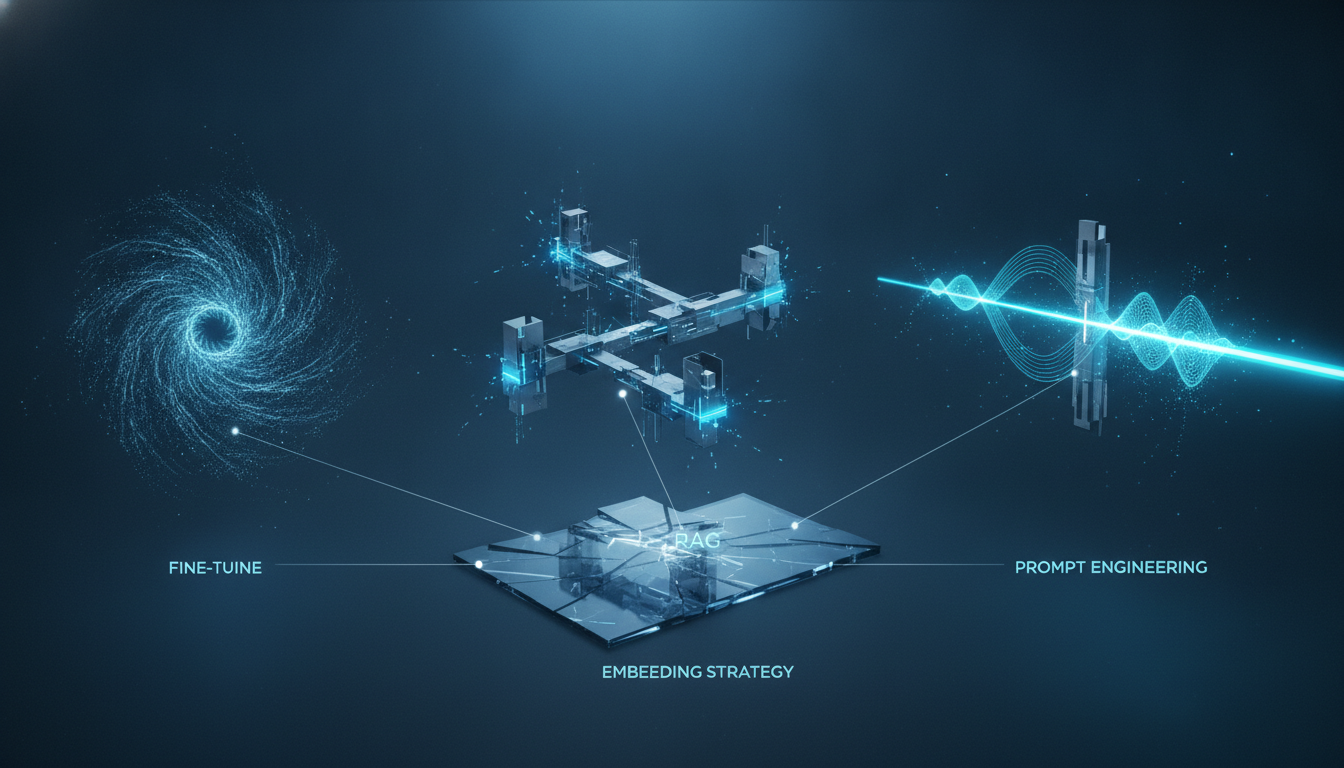
The decision between fine-tuning, retrieval-augmented generation, and prompt engineering shapes everything downstream in a domain-specific agent deployment — the data infrastructure required, the latency profile, the ongoing maintenance cost, and the ceiling on accuracy. Practitioners who treat these three techniques as interchangeable options are consistently the ones who rebuild their pipelines six months later, after discovering that the method chosen cannot meet the operational demands of the vertical they are serving.
Why the Framing Matters Before the Framework
Most teams approach this decision backwards. They start with what they have — a corpus of documents, an existing model, or a tight deadline — and reverse-engineer a justification for the technique that fits their current constraints. That approach almost always produces a system that performs adequately in controlled demos and degrades under real operational load.
The correct starting point is not the data or the model. It is the failure mode. What does a wrong answer cost in this deployment context? In a clinical decision support context, a hallucinated drug interaction can cause direct patient harm. In a customer service context, the same hallucination wastes ten minutes of an agent's time. Those two failure modes require completely different architectural responses, and the choice between fine-tuning, RAG, and prompt engineering flows directly from that analysis.
A second framing question concerns the nature of the knowledge the agent must carry. Knowledge can be behavioral, meaning it governs how the model reasons, responds, and formats its output. It can also be factual, meaning it concerns specific facts about the world, a domain, or an organization. These two categories map imperfectly but meaningfully onto the three techniques. Behavioral knowledge is best encoded through fine-tuning or prompt engineering. Factual knowledge, especially when it changes frequently or spans a large corpus, is best handled through retrieval.
Prompt Engineering: The Minimum Viable Intervention
Prompt engineering is the practice of constructing, structuring, and iterating on the input context passed to a base model in order to shape its behavior without modifying its weights. It is the fastest path to a functional agent and, when the deployment scope is narrow and the required behavior is stable, it is often the right path rather than merely the expedient one.
The architectural implication of prompt engineering is that all knowledge the agent needs must fit within the model's context window, or must be synthesized into system instructions that the model can apply generatively. For a vertical-specific agent that needs to respond in a particular tone, follow a specific escalation logic, or apply a defined set of business rules, a well-crafted system prompt with few-shot examples can produce high-fidelity behavior at near-zero additional infrastructure cost.
The limitations surface quickly in two scenarios. The first is when the required context exceeds what a prompt can hold without degrading model attention and accuracy. The second is when the agent needs to reason over facts that were not in the model's training data — proprietary records, recent events, or domain-specific knowledge that the base model simply does not have. Neither of those problems can be solved by making the prompt longer or more elaborate.
A third failure mode for prompt engineering is consistency drift across large agent networks. When dozens or hundreds of agent instances are running in parallel, prompt versioning becomes a maintenance problem. A small change to a system prompt propagates inconsistently unless the deployment architecture treats prompt templates as versioned artifacts with the same rigor applied to application code. Teams that skip that infrastructure step often find that agent behavior varies in ways that are difficult to diagnose without a structured audit trail.
RAG: When Factual Grounding Outweighs Behavioral Consistency
Retrieval-augmented generation inserts a retrieval step between the user query and the model's response generation. The system queries an external knowledge store — typically a vector database containing embedded representations of a document corpus — and injects the most relevant retrieved chunks into the model's context before generation begins. The result is a model that can reason over facts it never saw during training, without any modification to its weights.
The case for RAG is strongest when the domain knowledge is voluminous, changes frequently, or is proprietary to the organization. A legal agent that must reason over a firm's internal contract templates, a procurement agent that needs current supplier pricing data, or a compliance agent that must apply the latest regulatory guidance cannot rely on a base model's parametric knowledge. RAG lets the deployment pull current, specific, verified content into each response rather than depending on a model's generalized approximation of what that content might say.
The data infrastructure requirements for RAG are more significant than is often acknowledged in early planning. The knowledge base must be chunked thoughtfully — too large a chunk and retrieval loses precision; too small and the model loses context. The embedding model used to index the corpus must be aligned with the embedding model used to encode queries at inference time. The vector database must be sized and indexed to serve retrieval latency targets that are acceptable within the agent's response time budget. None of these are trivial engineering decisions, and all of them interact in ways that require testing at realistic load.
RAG also introduces a retrieval failure mode that prompt engineering does not have. If the retrieval step returns the wrong chunks — because the query was ambiguous, the corpus was poorly chunked, or the embedding model failed to capture the relevant semantic relationship — the model will generate a grounded-sounding response based on wrong evidence. This class of failure is more dangerous than a hallucination in some respects, because the model's confidence calibration often signals correctness when it is not. Robust RAG deployments require a reranking layer, query expansion logic, and adversarial testing against known retrieval failure cases.
Fine-Tuning: Behavioral Encoding at the Weight Level
Fine-tuning modifies the model's weights by continuing training on a curated dataset that reflects the desired behavior in the target domain. The result is a model that has internalized the statistical patterns of that domain — its vocabulary, its reasoning style, its output structure — without requiring those patterns to be re-specified at inference time through a prompt.
Fine-tuning is the right choice when the required behavior cannot be reliably produced through prompting alone, when the model needs to generalize a style or reasoning pattern across a wide range of inputs rather than follow a fixed template, or when inference cost and latency require minimizing the tokens consumed by lengthy system prompts. A model fine-tuned on structured extraction tasks in a specific vertical will often outperform a prompted general model on the same task while consuming fewer input tokens per inference call.
The data requirements for fine-tuning are the most demanding of the three techniques. The training dataset must be large enough to produce generalizable behavior, clean enough that it does not introduce noise into the model's weight distribution, and representative of the full input distribution the agent will encounter in production. In practice, assembling a high-quality fine-tuning dataset for a specialized vertical often takes longer than the fine-tuning run itself. Teams that underinvest in dataset curation and then wonder why fine-tuning underperformed relative to expectations are experiencing a predictable outcome of that tradeoff.
A second constraint on fine-tuning is model selection. Not every base model is fine-tuneable in a cost-effective way for every deployment context. Parameter-efficient fine-tuning methods like LoRA reduce the compute cost significantly, but they also limit the degree of behavioral change that can be encoded. Full fine-tuning of a large model requires GPU resources that are not available in every deployment budget. The decision to fine-tune therefore implicates a model selection decision and a compute budget decision simultaneously, and those decisions interact with each other in ways that must be modeled before committing to the approach.
The Decision Framework: Four Diagnostic Dimensions
When should a domain-specific agent deployment use fine-tuning versus RAG versus prompt engineering, and what is the decision framework? The question has a structured answer that unfolds across four diagnostic dimensions, each of which must be evaluated before a technique is chosen.
The first dimension is knowledge type. Behavioral knowledge — how the agent reasons, formats, escalates, and communicates — is best encoded through fine-tuning or prompt engineering. Factual knowledge — what the agent knows about the world, the domain, or the organization — is best served by RAG. When both types of knowledge are required, the answer is usually a combination architecture, with fine-tuning or a structured prompt handling behavior and RAG handling fact retrieval.
The second dimension is knowledge volatility. If the facts the agent needs to know change more frequently than a reasonable fine-tuning cycle permits, RAG is almost always the better choice for the factual component. If the behavioral requirements are stable, a fine-tuned model or a locked prompt template can safely encode them. If both facts and behavior are volatile, the architecture must treat each independently with different update cadences.
The third dimension is failure cost and failure mode. In high-stakes verticals where a wrong answer causes direct harm, the priority is grounding the model's responses in verifiable retrieved evidence rather than in parametric weights that cannot be audited. RAG makes it possible to inspect the evidence the model was given before it responded. Fine-tuned model outputs are harder to explain in terms of specific training examples. Prompt engineering sits in between — the reasoning chain is visible if chain-of-thought prompting is used, but the factual grounding depends on what was injected into the context.
The fourth dimension is operational scale. At small scale, prompt engineering is nearly always the right starting point. As the deployment scales in agent count, query volume, and vertical diversity, the maintenance cost of prompt versioning increases and the value of encoding behavior in weights grows. Fine-tuning becomes more attractive as the amortized cost of the training run is divided across a larger number of inference calls. RAG infrastructure becomes more cost-effective as the query volume grows relative to the fixed cost of maintaining the knowledge base and vector index.
Combination Architectures and the Embedding Layer
The real-world answer for most production-grade domain agent deployments is not a single technique but a combination. A fine-tuned model handles the behavioral layer — domain-specific reasoning style, output format, escalation logic. A RAG pipeline handles the factual layer — retrieving current, organization-specific content on demand. A structured system prompt bridges the two, providing the task framing and any static context that neither the fine-tuned weights nor the retrieval results can supply.
The embedding strategy decision extends beyond which technique to use and into how the embedding layer is structured across the combination. In a RAG-plus-fine-tune architecture, the embedding model used to index the knowledge corpus should ideally be evaluated against the fine-tuned model's behavior to ensure that the retrieved chunks align with what the fine-tuned model has learned to expect. A mismatch between the semantic space of the retrieval index and the semantic space the fine-tuned model reasons in creates subtle accuracy degradation that is difficult to diagnose without systematic evaluation.
The embedding layer also governs how knowledge is chunked and stored in the vector database. Fixed-size chunking is simple but loses document structure. Semantic chunking, which splits on meaning rather than token count, produces higher-quality retrieval but requires more sophisticated preprocessing. Hierarchical indexing, which stores both summary-level and detail-level embeddings for each document section, allows the retrieval step to first identify the relevant document and then retrieve the precise passage — a pattern that significantly improves precision in large corpus deployments.
Metadata filtering adds a retrieval precision layer that pure semantic similarity cannot provide. By tagging embedded chunks with structured metadata — document type, date range, regulatory jurisdiction, product category — the retrieval query can be constrained to semantically relevant and structurally appropriate content simultaneously. This approach requires upfront investment in a metadata schema and population pipeline, but it pays compounding dividends as the corpus grows.
Evaluating Framework Fit Before Committing to Architecture
Before any architecture is chosen, a structured evaluation process should map the deployment requirements against the four diagnostic dimensions described above. That evaluation should produce a clear specification of which technique handles which knowledge type, how each component will be updated when knowledge changes, and how the combination will be tested before production.
The evaluation should also surface any hard constraints that eliminate certain techniques from consideration. A deployment context that requires sub-200ms response latency may not be compatible with a RAG pipeline that adds a retrieval round-trip to each query unless the retrieval infrastructure is engineered specifically for that latency target. A deployment context with a training budget too small to assemble a quality fine-tuning dataset should default to prompt engineering plus RAG until the data collection problem is solved.
TFSF Ventures FZ LLC embeds this evaluation as a prerequisite step in every deployment engagement, using a 19-question operational intelligence assessment that surfaces the knowledge type, volatility, failure cost profile, and scale requirements specific to each vertical before any architecture is committed. That assessment drives the architecture specification rather than allowing tool familiarity or deadline pressure to determine the technique selection. The result is that the architecture chosen is the one that fits the operational requirements, not the one that was most convenient to implement.
Maintenance Architecture and the Update Cycle
Choosing a technique at deployment time is only half the architecture decision. The other half is designing the maintenance cycle that keeps each component accurate as the domain evolves. Fine-tuned models require a retraining pipeline that can be triggered when accumulated evidence shows that the current weights no longer produce acceptable behavior on the target distribution. That pipeline requires a curated evaluation set that reflects production inputs, automated regression testing against that set, and a deployment process for rolling out the updated model without disrupting active agent operations.
RAG knowledge bases require a different maintenance architecture. The ingestion pipeline that populates the vector index must handle document updates, deletions, and version control without creating stale or duplicate embeddings. A document that has been superseded by a newer version should be removed from or deprioritized in the retrieval index, not left in place to compete semantically with its replacement. Organizations that treat their RAG knowledge base as a write-once store rather than a managed data infrastructure consistently experience retrieval quality degradation over time.
Prompt templates require the simplest maintenance architecture of the three, but they are not maintenance-free. Templates should be version-controlled, tested against a regression suite before deployment, and audited periodically to ensure they still produce the intended behavior as the underlying model is updated by its provider. Model providers do update base models, and a prompt that produced reliable behavior on a previous model version may not produce the same behavior on the current one.
Production Exception Handling Across Techniques
Every technique has characteristic failure modes in production that must be anticipated and handled architecturally rather than treated as edge cases to be addressed reactively. For prompt engineering, the primary production exception is context overflow — when the total tokens in the system prompt plus the user query plus any injected content exceed the model's context window, the system must have a defined truncation or summarization strategy that preserves the most operationally critical content.
For RAG, the primary production exception is retrieval failure — when no retrieved chunk is sufficiently relevant to the query to support an accurate response. A robust RAG deployment must detect this condition and respond with a defined fallback behavior rather than allowing the model to hallucinate a response based on inadequate retrieval context. Detection typically requires a confidence threshold on retrieval similarity scores, validated against a labeled set of known-bad retrieval cases.
For fine-tuning, the primary production exception is distribution shift — when the production input distribution diverges from the training distribution in ways that cause the fine-tuned model to behave unexpectedly. This requires continuous monitoring of production outputs against the evaluation criteria established during the fine-tuning process, with automated alerting when degradation is detected. TFSF Ventures FZ LLC's deployment methodology treats exception handling architecture as a first-class deliverable rather than an afterthought, ensuring that each technique's characteristic failure modes are addressed before the system moves to production.
Cost Modeling Across the Three Techniques
The cost profile of each technique differs in structure as well as magnitude. Prompt engineering has a near-zero upfront infrastructure cost and an ongoing cost that scales linearly with inference volume, because longer prompts consume more tokens per call. Fine-tuning has a significant upfront compute cost and ongoing inference cost that may be lower than prompt engineering on a per-call basis if the fine-tuned model requires shorter prompts to achieve the same behavior. RAG has ongoing infrastructure cost for the vector database and embedding model, plus the retrieval computation that adds to each inference call.
For organizations evaluating TFSF Ventures FZ LLC pricing, deployments start in the low tens of thousands for focused builds and scale based on agent count, integration complexity, and operational scope. The Pulse AI operational layer is structured as a pass-through at cost based on agent count, with no markup applied. Every client owns the full codebase at deployment completion, which means there is no recurring platform license tied to continued operation. That ownership model changes the long-term cost calculation significantly compared with subscription-based agent platforms where the operational cost compounds indefinitely.
Vertical-Specific Considerations
The diagnostic framework described above applies universally, but its outputs vary significantly by vertical. In financial services, regulatory compliance requirements favor RAG over fine-tuning for factual retrieval because auditors can inspect the retrieved documents that grounded a specific model output. In healthcare, the combination architecture — fine-tuned behavior with RAG factual grounding — tends to dominate because both behavioral precision and factual currency are operationally critical. In logistics and supply chain, where operational data changes by the hour, RAG pipelines backed by real-time data feeds are often more valuable than either fine-tuning or sophisticated prompt engineering.
Those who ask whether TFSF Ventures legit as a deployment partner, or look for TFSF Ventures reviews in terms of verifiable credentials, will find the answer in the publicly registered RAKEZ License 47013955 and the documented 30-day deployment methodology applied across 21 verticals. The legitimacy question is answered by institutional registration and operational track record, not by invented testimonials. The 30-day deployment timeline is achievable precisely because the diagnostic framework described in this article is applied before any engineering work begins, ensuring that architecture decisions are made once rather than revisited mid-deployment.
TFSF Ventures FZ LLC operates as production infrastructure — the systems deployed are not demonstration environments or consulting recommendations. They are production-grade agent deployments running in the systems the client already operates, with exception handling architecture, versioned prompt management, and retrieval infrastructure built to production standards from day one. The 30-day methodology compresses the timeline not by skipping steps but by running the diagnostic and architecture phases in parallel with environment preparation and integration mapping.
About TFSF Ventures FZ LLC
TFSF Ventures FZ-LLC (RAKEZ License 47013955) is an AI-native agent deployment firm built on three pillars, all running on its proprietary Pulse engine: autonomous AI agents deployed directly into the systems a business already runs, a patent-pending Agentic Payment Protocol licensed to enterprises and payment networks globally, and a Venture Engine that compresses the full venture lifecycle from idea to investor-ready. Founded by Steven J. Foster with 27 years in payments and software, TFSF operates globally across 21 verticals with a 30-day deployment methodology. Learn more at https://tfsfventures.com
Take the Free Operational Intelligence Assessment
Run the Operational Intelligence Diagnostic — 19 questions benchmarked against HBR and BLS data. Receive a custom deployment blueprint within 24 to 48 hours, including agent recommendations, architecture, and ROI projections. Start at https://tfsfventures.com/assessment
Originally published at https://www.tfsfventures.com/blog/fine-tune-vs-rag-vs-prompt-engineering-the-embedding-strategy-decision-framework
Written by TFSF Ventures Research